Unknown's avatar

About ContentRambler

Part time blogger, employee, mum, enjoying rambles around the country of content, social networks, and blogging. Marketing tourist.

Blogging impressions: how to get to the point

How much did you write when you started blogging?

When I started blogging I wrote with no aim in mind except that of writing. Because I simply had to write. Needless to say my posts were long, not to say rambling… One of my first ‘Blogging impressions’ posts was about getting a sense of focus into a blog post, for good reason 🙂

Writing along or getting to the point

The prescribed treatment helps if you’ve written a blog post and you’re wondering if you could have made it shorter than 1000 words… and whether you should make any alterations, and how. Continue reading

Storytelling in the age of content marketing

Has content marketing changed consumers?

My version of the customer decision journey

My colorful version of the customer decision journey. Click to view McKinsey’s version.

The question popped into my mind while reading this blog post on Pamorama. Pam neatly shows two models for the process a customer goes through before (and in the second case, after) they make a purchase.

There’s quite a difference between the two models. But does that difference reflect a change in consumers? If so, did content marketing cause that change?

The pre-content marketing sales funnel

The pre-content marketing sales funnel shows a straightforward process with a beginning and an end. At the end, you’ve bought something. Congratulations! Goodbye – and you never hear from the (web) shop again.

When, if ever, did this sales funnel model match reality? Under what circumstances is there no contact between ‘shopkeeper’ and consumer after the purchase – or, would one map only this part of the process? Continue reading

How your job experience will help you get your ideal career

Do you ever feel you’ve wasted years in all the wrong jobs? The bad news is you can’t get those years back. The good part is it was not all in vain.

What career perspective are you looking at?

Job experience is seldom wasted

If you feel you’ve mindlessly pulled someone else’s plough for years and think you’ve got nothing to show for it but sores, think again. Take writing, for example. Continue reading

Online conversations: is automation worth your while?

A while ago there were plenty of blogs, including my own, reporting on the ways (fake) Likes, fans and followers on social media were at the heart of a commercial industry. Bloggers and heavy users of social media tend to automate or streamline at least part of their interactions.

Can you automate part of your actions without appearing – or being – ‘fake’ in the human sense? Should you?

Levels of engagement in conversations

Visitors and commenters: to automate - or not?The level of engagement involved in an online conversation can differ enormously. Dealing with online conversations can cost you hours upon hours. ‘Likes’ don’t seem to get a lot of follow-up by companies. However try to check up once a week or so – getting zero response is discouraging.

Related posts: Twitter automation, and A Clone War.

The role of automation in online conversations

What actions can you safely automate?

  1. Standard replies like “Thank you for the follow!”, “Thanks for the RT”, “Thanks for the mention”. This category was hit by Twitter’s decision to make automated actions by tools like IFTTT difficult. Meanwhile tools like Commun.it still collect new followers and interactions and compose standard messages for you to send. My advice: edit them.
  2. Messages on repeat thanks to tools like Buffer, like “Read my post on subject X” for the umpteenth time. My main problem is with people who quote at me when they’re not even online 🙂

Automating your responses to questions

While it’s up to you to decide what to automate, here’s my tip:

Try not to fool people into thinking they have a personal and meaningful relation with you when they don’t.

Answering questions literally on autopilot is tricky and that’s why not many businesses are doing it (yet). I once asked a new follower who had sent an automated “Thanks for the follow” tweet if they’d had a busy week, and the response was something like “Busy week! Check my FB page…”

I can’t tell you how to do this type of automation on Twitter without IFTTT but it’s probably either down to your budget or your technical abilities. But that’s beside the point.

Questions indicate a sincere interest in a topic or in you. Personally I would say never automate this type of action. Not even to seem polite.

Comments – the life blood of conversations

This is what you can’t yet leave to an automation tool (unless you have a really big budget). You don’t need me to point out that all comments are not equal. I suppose you could automate replies to really short “Great Post!” comments but is saying “thanks” really that much of a time waster?

For the more relevant comments: if you’re used to putting yourself on the stage through blogging or on social media, don’t forget others are not. The important thing here is to have a heart 🙂

Blogging impressions: your blog as an online portfolio

Apart from if you’re actually a professional blogger, what’s the use of having a blog?

Why would you want to blog at all?

What is in your blogging portfolio?

Portfolio cover of color plates by Charles S. Graham. Field Museum Library

  • Because you enjoy writing (or making videos, in case you’re into video blogging).
  • Because you don’t mind (or love) the attention.
  • Because you don’t mind the kind of work involved: writing, getting or creating pictures or videos, making sure your content is properly tagged so people who don’t know you will still find you by searching for the topics that are on your blog.
  • Because you need a portfolio. You need to create content for whatever purpose.

Even if you don’t start blogging for that purpose, posting fresh content on your blog will eventually build a portfolio of your content. What would you like to do with it?

Why would you want an online portfolio, and of what?

What goes into your portfolio – that is, onto your blog – shows a couple of things about you as a blogger which may be of interest to a potential client or employer:

  1. That you can write – in a language of your choice. (In my case I might have written in Dutch, but I chose English instead).
  2. That you’re able to create content to a schedule. That may mean posting daily, but it doesn’t have to be that intense. Once a week can be enough. Keeping it up for any length of time and consistently producing good or at least acceptable (although you should aim higher) content costs time and energy. Can you keep it up and still enjoy blogging?
  3. That you’re able to build a community around your blog. You may do so on your blog, or off – I know people who have little interaction on their blog, but much more on Facebook. In my case, readers react on my blog, on Twitter, or on LinkedIn.

Your blogging portfolio as a (first?) step in your career

A potential employer or client may be interested in one aspect of your blogging efforts or all:

  • content creation as a creative process
  • regular content production
  • community management on or off your blog

And of course depending on what you blog about, they’ll get some idea of you as an expert on one or more topics – and as a person.

What kind of portfolio is your blog turning into – and could it support your chosen career?

The importance of feedback for your learning

Whenever you are learning something new, there’s nothing more important than the feedback loop  – you need to know how you’re doing at your task. This helps you improve your learning process to bring that moment nearer when you’ll be able to say “Yes! Now I can do this.”

Feedback Loops And 'Learning'

A demonstration of what the right feedback loops and algorithms can do in machines.

I recently watched a video from Zurich.MINDS and really only got interested when Raffaello D’Angelo started talking about feedback loops in computerized machines. Continue reading

Time to update your resume (and find the right job, part 2)

A while ago I wrote about your LinkedIn profile and LinkedIn summary and so on. But what about the old-fashioned resume? Is it gone forever?

Job News On LinkedIn. How's your resume?

My News On LinkedIn Today
[click link to read the article]

Somehow I doubt that. But LinkedIn is a great place to organize your resume if you’ve never bothered to do so – or if it’s been a long time so you feel as though you’re starting from scratch.

If you want to apply for a job using video, it’s worth reviewing your previous activities. In a way, your resume is just a way of keeping score – a means to an end.

It’s worth reviewing your past employments through the eyes of your potential employer. What are they about, and how do you fit into their picture?

Update your resume: mind your language

If you’ve been (un)employed for a long time, getting back into the old resume-making routine (was it ever a routine?) may cause you to create sentences with a vocabulary that was out of fashion well before the 21st century started.

Size up your future employer:

  • What clues does the company website yield about the nature of the organization and its employees, language-wise?
  • Check the LinkedIn profiles of a few employees to enhance the picture.

In very formal organizations, little may have changed over the years. Everywhere else is a different matter. Don’t use the language you would have used twenty years ago.

Resume add-on? Writing your motivational letter

The letter or video to go with your resume should contain as little as possible from your resume. This is where you show your potential employer:

  1. Who you are as a professional and what you’ll bring to the company.
  2. No less important is what you’ll get from the company.

#1: What can they expect in terms of skills, knowledge, and work attitude? Don’t put anything in there that’s not you. I don’t just mean inventing skills you don’t have, but also presenting yourself as more proactive, or more pliable, than you really are.

Tip: being turned down for who you are is bad enough. Don’t get turned down for trying to be like someone else. I’ll admit this sounds like dating advice 😉

Does #2 sound odd? How about getting the chance to do new projects, meeting new people, or making sense of the organizational mess they’ve made? What a company has to offer you is working experience. Lots of it. If it’s the right kind of experience, so much the better. If not, keep the valuable bits of your newly found knowledge and run.

After a friend of mine left a company he said: “That was a complete waste of my time”. It wasn’t. He’ll never, EVER, apply for a job in that branche again, or for that type of job, without being aware of the potential pitfalls. It’s that easy. Next time you’ll know better. Unless you fail to learn.

What have you learned from your previous job?

How a content strategy will help your blogging career

Suppose you want to turn blogging – or let’s call it content creation – into a career. The first thing it means is that you need a business attitude at least where it comes to how much content you’ll create about what topic(s). What you really need is some kind of plan for your content.

A Content Strategy is important for your blogging career. So is Meditation. Relax...

What are the characteristics of a (good) content strategy anyway? I ran into a nice, possibly helpful definition on Business2Community, to which I’ve decided to add my own perspective in this post.

A content strategy for your blogging career

Having a content strategy means you

  • deliberately create content
  • which you have optimized for search. This means that you base your content on keyword phrases that drive ‘organic search traffic’ (and conversions) – this is what the article I mentioned focuses on,
  • that demonstrates an understanding of your potential customer’s knowledge acquisition at various stages in their buying cycle. Don’t worry, I’ll explain later 😉

This means you don’t write whatever you like – a different approach from what you’d do on a personal blog. Instead, you start by finding out what keyword phrases your potential customers are probably using to find the information they need.

What kind of content is your potential customer looking for?

Put yourself into your customers’ shoes for a moment. What information you need depends on several aspects:

  1. Whether you’re already familiar with a type of product or service. Do you need to know what different smartphones do, or do you own one and do you want to compare the latest smartphones with yours?
  2. Whether you’ve already decided which product or service you want, or from which company you’ll buy.
    1. You may want to compare prices to get the best deal regardless of the brand so long as the product meets your demands.
    2. Or you know what product you want. All you need to know is which site or company offers you the best deal.
    3. Or you’re fed up with the lousy service you’ve had from company X and you need to make sure you find a company that does know that “customer service” contains the word “service” for a reason.

Every different situation means you’ll be using different keywords while looking for information.

A content strategy that is optimized for search means you take your potential customers’ search behavior into account even before you start creating content for your blog (or website).

What do you know about your potential customers? Can you ask any of the customers you already have?

Delivering your content to your potential customers

Next: you deliver your “optimized” content to your potential customers in a relevant and compelling way.

What is relevant depends on what your readers and/or your potential customers are looking for, not what you feel is important for you to tell the world.

Compelling is a word I’ve seen too often since I started reading about content marketing, and relevance takes care of a lot. True, it doesn’t help if you analyze quite interesting stuff down to the level of atoms for potential customers who either want you to help them or to entertain them. On the other hand, maybe you’re doing exactly the right thing to attract the people you need for your business. Do you know?

What kinds of content can you deliver on your blog?

A couple of categories of content that could work in the context of your blog are:

  1. Case studies that show how you dealt with a particular kind of issue. This lets people know what to expect from you.
  2. The ‘how to’ posts are familiar and they can be quite popular. However a post doesn’t become popular just because the title starts with “How to…”. Again, relevance to your potential customers matters most.
  3. White papers that give in-depth information to those readers you’ve selected as possibly interested in more than the average blog post.
  4. News about events you attend or organize, so people know where/when to find you.

Final considerations for a blogging career

If you’re serious about a blogging career you also need to consider which format suits your potential customers, and where they hang out for preference.

  • Are they the reading kind or do they prefer video?
  • Do they write lengthy comments on your blog or do they drop a short line on Twitter?

If, like me, you’re writing for the fun of writing, or to help your thinking process along, these considerations are probably not for you. But if you’ve decided to try to make money blogging, you’ll need to cater for your potential customers’ preference rather than stay in your own cosy comfort zone wondering where they went.

Why you don’t want this job – and how to get the right job, part 1

My previous ‘career’ post was about leaving your job. On the flip side is getting a new job (hopefully). If you’re looking for a job, hearing me say “you don’t want this job” probably sounds balony. So – is it?

Do your homework, get a job
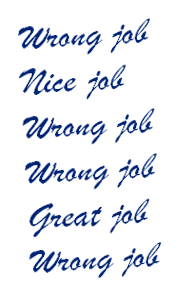
Your Career: Right Job Or Wrong Job

Right Job Or Wrong Job?
Only you can tell. Hopefully

This is what most of us consider normal nowadays: do some research into your potential employer. View a couple of LinkedIn profiles of people who work there – maybe you’ll find one of them even blogs. You’ll get to know a lot about the people who may become your coworkers. So far, so good.

But what if you’re so good at job interviews you land the wrong job?

Thanks to a comment I got thinking about this. Some of us are just too competitive. Landing a job becomes a sport in itself. Or you’re applying for every job you can think of just to get the money rolling in. Then you get an offer. One offer.

Your future employer maybe made the job sound a bit more glamorous than it really is. This happens to any job that contains a lot of routine work. Employers dial up the interesting bits, and dial down the days and days you’ll spend staring at a screen churning out numbers or client data.

How to get the right job

Start by getting a clear picture of what you want from a job – apart from the money. Even if you feel this isn’t the right time to be getting critical, you need a reference point to tell if a job is 80% your kind of job, 50%, or only 20% (you’ll probably spot that last one effortlessly).

Check if your estimate is right at your job interview. The match determines how fast you’ll be looking for your next job.

Questions to ask yourself:

What do I love to do?

In my case, I wanted to become an archaeologist when I was a kid. Leakey-style. Digging in the sand to unearth the most amazing fossils. As an adult, I dug around in archives and found some beautiful specimens 😉

I still enjoy combing the long beach of the internet for interesting stuff, and building sand castles on my blog. The nature of a specific job doesn’t change what I love to do.

What do you enjoy doing? What’s the common denominator in your life and career?

What do I have to offer to this potential employer?

How can you help this particular organization doing this job? What are your strengths? What knowledge have you already gained? Sometimes you think you have an answer and you’ll find that your future employer has different ideas of what you have to offer.

I was called “over qualified” so I depended on employers who would let me prove I wouldn’t run away screaming after a few weeks. Then one day I ran into an organization where affinity with art actually helped me get a job over several other candidates who had applied before me. And I didn’t know my background had triggered their interest until the job interview.

Tip: be careful what you leave out of your resume.

What does this job have to offer for my career?

Let’s break this one up into a few pieces:

  1. What tasks does this job entail that are part of the career I would like?
  2. How much time will I be able to spend on those tasks?
  3. What new experience will I gain doing all this?
  4. And a tricky one, do I have a specific goal for the next few years?
  5. If the answer to #4 is yes, how long (minimum) do I want to stay?

Tip for #4: At the organization that offered me an archiving job I could also do the research for my part-time study. That saved me an internship that would have meant little income for months. Did I mention this at my interview? Yes.

Tip for #5 (or 4B): Be prepared for this question. Your potential employer wants to know if you’re worth investing time and training – if you’ll stick around for a while after you reach your own goal.

Read more:

An article on Exertusjobs aimed at anyone over 50. But I’d say you can read it if you’re younger.

An earlier career post I wrote on this blog.

You may have gathered I got the job in spite of, or thanks to, my honesty. It was a what-you-see-is-what-you-get deal. It worked for me. What works for you?

Blogging impressions: using images on your blog

It’s been a while since I wrote a ‘Blogging Impressions’ post. Here goes.

You may have noticed I’m a writing blogger… Even so, I like to have an image with every post on my blog.

Blogging Images for your blog

Pros of images on your blog

  1. It’s good for SEO (search engine optimization). Provided you add key words in the ‘alt’ (alternative text) box.
  2. It adds interest.
  3. You may even add your personal twist through the description.

Cons

  1. It takes time to find the right picture(s), unless it’s part of your daily activities anyway, and in business topics, to come up with an original picture which you can still use in a sensible way to enhance your post. Is anyone fed up with pictures of keyboards with a key saying anything from “Sell” to “Engage” yet?
  2. Time. To upload. To fill all the ‘metadata’. To add a description that bridges the gap between text and image in a meaningful way.
  3. Did I mention ‘time’? I’m a bit short right now 😉

Ways to find the right images for your blog

So far I’ve tried several approaches for images (call it “visual content”) on my blog:

  • Making them myself using PowerPoint. The results vary enormously depending on the time I have left when I decide to make an image rather than looking for one.
  • Taking pictures. I’m still learning when it comes to producing my own visual content in any form: whether it’s a cartoon, or a photograph. I keep practising though, but on my last holiday I completely forgot the camera I got last Christmas. The photograph I’ve added is one I made using an iPhone (4, in case you wondered). I halved its size before adding it to my blog.
  • Looking for them on Flickr – either in the “Creative Commons” section or by adding “Creative commons” to my search terms.
  • Looking for them on Flickr, specifically in the photos added by fellow blogger HikingArtist.com – perfect for blogs dealing with business or nature.

How do you get the right images for whatever content you want to share on your blog?